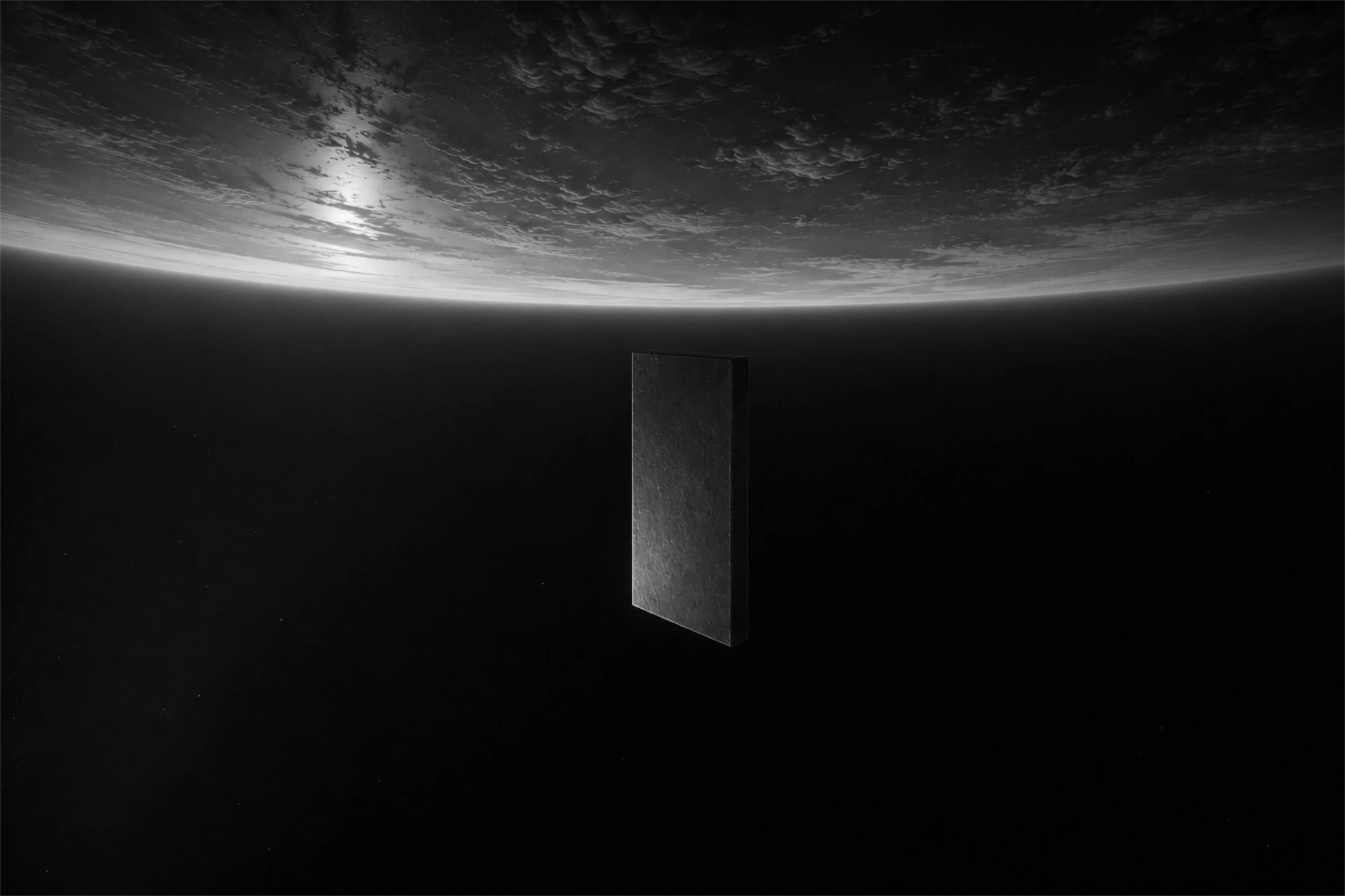
Orbital Art Lab header image

ORBITAL ART LAB

a laboratorium for artistic practice in space

The Orbital Art Lab is a conceptual art studio in space. It is a personal artistic practice that transposes an earthly way of working into the space environment and that researches and engages with everything that follows from that. It is medium-agnostic and open-ended.

Orbital Art Lab 1.0 - NASA JPL The Studio

The first iteration of an Orbital Art Lab began in 2013 at NASA's Jet Propulsion Laboratory in Pasadena, where I worked as a Visual Strategist. At JPL I was embedded in The Studio: a small team of artists led by Dan Goods and David Delgado that operated inside one of the world's most advanced space engineering organisations. Artists at The Studio worked alongside mission scientists and systems engineers from the earliest phases of mission development, not as communicators or illustrators, but as creative practitioners who could expand the conceptual territory of a mission. I contributed to projects including the GRACE-FO satellite, the Rosetta mission to comet 67P, and the JUNO mission to Jupiter, developing artistic engagements that ranged from mission identity to sensory data interpretation to proposals for space-bound artistic components. This period established the foundational premise of the Orbital Art Lab: that artistic practice and space mission development are not just compatible but can operate on the same level.

Orbital Art Lab 2.0 - The Spacecraft Agency

The second iteration grew from a 2020 invitation from Luke Idziak at NASA Ames Research Center to create an artistic intervention on PACE-1, a 6U cubesat scheduled for launch to Low Earth Orbit. Luke and I structured our collaboration as The Spacecraft Agency, an informal curatorial framework designed to remove the overhead and institutional anxiety that typically surrounds artistic space projects. Over multiple space missions we commissioned artists to create works specifically conceived for the satellite's surface and mission context, developed a technically validated application method in close collaboration with the mission engineering team, and successfully integrated the artworks into the spacecraft before launch. The project raised questions that have stayed with me since: how do you curate in space? Who is the audience? How does an artwork relate to an environment that no human eye will ever directly observe? These questions are not rhetorical but became the operational conditions of the practice.
The Spacecraft Agency is still operational and has launched multiple space art missions.

Orbital Art Lab 3.0 - The Foundry

The third iteration, The Foundry, is the current one. Set up as a non-profit organisation in collaboration with Luis Guzman, The Foundry operates a formal partnership with Aegis Aerospace to place artistic payloads on the MISSE (Multi-purpose ISS Experiment Flight Facility) platform, a facility mounted on the exterior of the International Space Station operated through a collaboration between Aegis, NASA, and the ISS National Laboratory. MISSE exposes payloads directly to the conditions of Low Earth Orbit: vacuum, microgravity, ultraviolet and ionising radiation, extreme thermal cycling, and atomic oxygen erosion. Payloads are installed during ISS operations and retrieved after the mission, then returned to Earth. This is the first time the Orbital Art Lab has had access to a controlled, retrievable exposure environment - meaning that for the first time, artworks that have genuinely been in space can be brought back, studied, and exhibited.
For me this marked the start of a complete new line of inquiry: Astromorphic Art - art that is specifically designed to interact with and be co-created by the space environment itself.

This opens questions the art world has not yet had to seriously deal with: who owns a space-flown artwork? What is its legal status? How do you exhibit something that carries the material trace of an environment no human has directly touched? What is its value, if it has one? How do you build a (curatorial) practice around objects made, exposed, and returned across a gap that no audience will ever physically cross?


Those questions are the work. The Orbital Art Lab exists to ask them in the most direct way possible: by actually doing it.

Orbital Art Lab 3.0 - The Foundry
Installation of a MISSE art payload on the International Space Station
Video: Aegis Aerospace