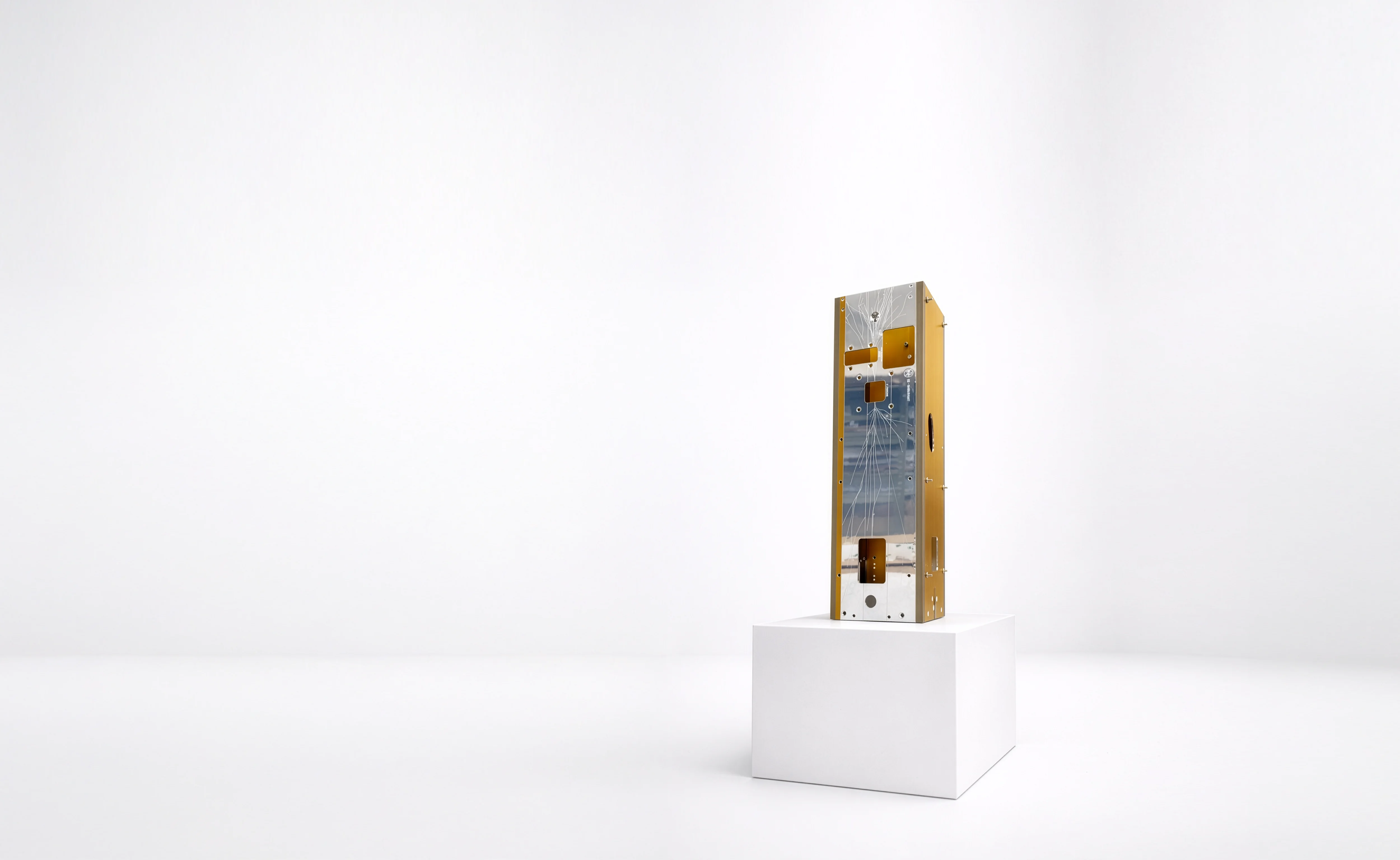
Neither a satellite nor a cosmic ray fully exists as what it is until they meet - that encounter produces, again and again, what neither carried alone.
Of Neither, Both
A galactic cosmic ray is just a cosmic ray. A satellite is just a satellite.
Galactic cosmic rays are particles accelerated to near-light speed by supernovae, neutron star collisions, the violent deaths of stars. What defines them is their solitude. Interaction, for a cosmic ray, is the exception not the rule: the vast majority of their journey is through emptiness, undeflected, invisible, leaving no trace and meeting nothing.
And then - here, on this satellite, at this moment - they finally meet something. The satellite, a small machine built by human hands and launched into the darkness, is for that particle the first thing it has touched in millions of years. When they encounter each other something new comes into being that neither carried alone: an artwork. This is not metaphor. It is the precise philosophical claim of Karen Barad's concept of 'intra-action': entities do not pre-exist their relations. They are constituted through them. The artwork does not pre-exist the encounter. The artwork is the encounter.
The score
It is based on this premise that Arno Geens created 'Of Neither, Both', his orbital artwork for the NASA TES-23 satellite.
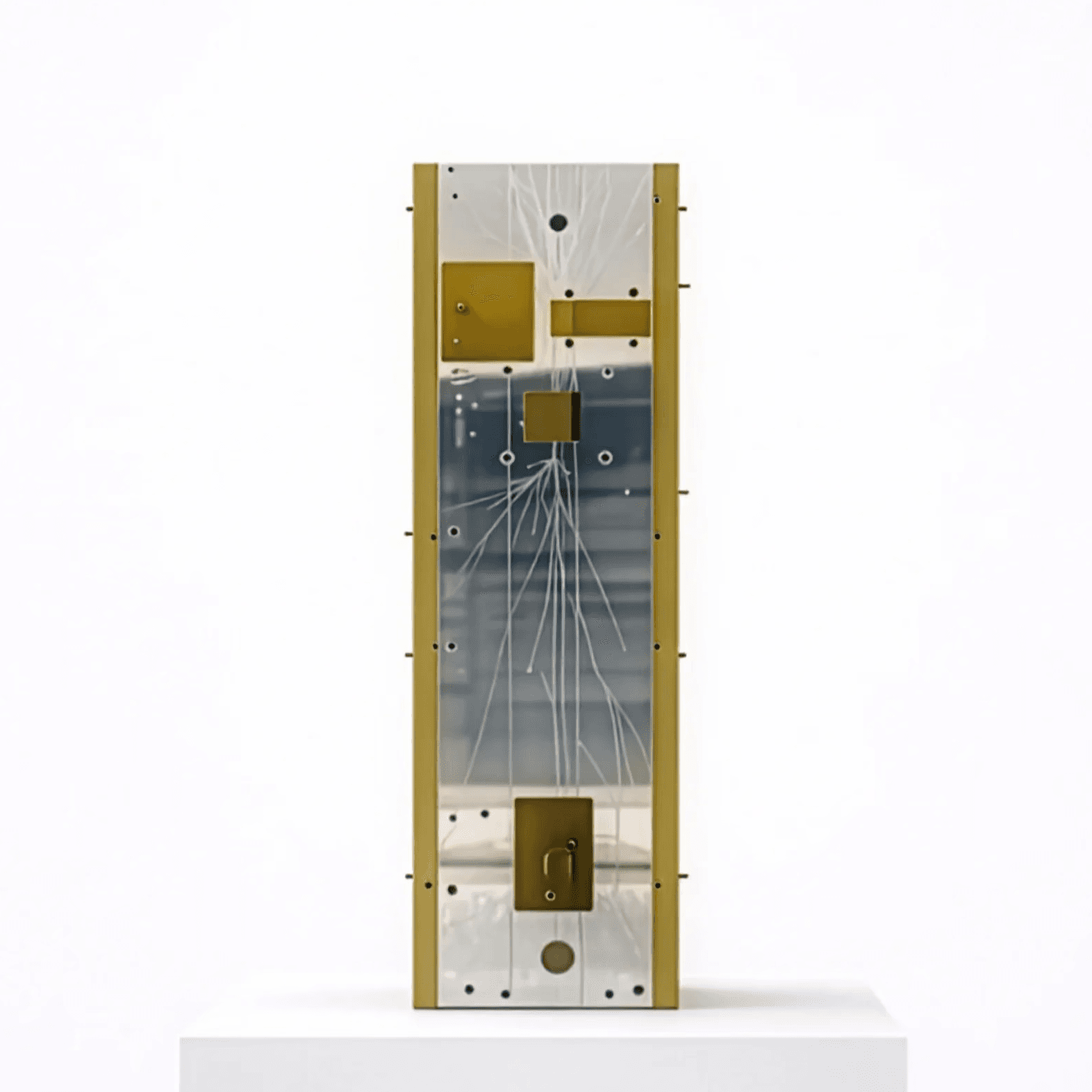
Before launch, Arno applied a laser-etched image on the satellite's body: a simulated cosmic ray interaction, a prediction of an encounter that has not yet happened. This is not the artwork. It is a score. The satellite enters orbit as a prepared apparatus, waiting for the universe to begin. The score could not be played on earth: our atmosphere absorbs and scatters galactic cosmic rays before they reach the surface. This work is only possible in the unshielded radiation field of low Earth orbit. The satellite had to leave the earth for the work to exist at all.
The intra-action
In orbit, the satellite enters continuous entanglement with the galactic cosmic ray field. There is no moment when they are separate and then encounter each other. From launch onward they are co-present, mutually implicated, 'intra-acting'. The work accumulates this exposure as a literal running count of what the satellite has absorbed. And within that continuous accumulation, the work watches for something: a threshold crossed, a moment when the built-up exposure marks a significant passage. When that moment arrives, a rendering tool, created by Arno, is fed the precise parameters of that instant: flux, energy, orbital position, space weather conditions. From these, it generates a new image: a single galactic cosmic ray disintegrating on contact, the primary particle shattering into a cascade of secondaries, each line a daughter born from the collision. A render: a specific, dated, unrepeatable determination of what the intra-action looked like at that moment. The series is not a collection of separate images but a single entanglement, cut into visibility again and again as it deepens.
The trace
The satellite will not return. When the mission ends it burns in the atmosphere, the apparatus consumed, the intra-action ended not by completion but by the destruction of one of its terms. What remains are the rendered works on earth: digital and material traces of encounters that no longer exist. Condensations of a relationship that, for a brief time, existed between a human-made machine and particles older than the solar system.
The satellite
TES-23 is a 3U satellite developed by NASA Ames Research Center, launched on March 30, 2026, aboard a SpaceX Falcon 9 as part of the Transporter-16 commercial rideshare mission. Small enough to hold in two hands, it carries three experiments: a Radiation Shielding Efficacy Testbed (RSET), which measures the effectiveness of radiation shielding designs for small spacecraft; a miniaturised NOAA data collection radio for Earth observation; and an exo-brake deorbiting device - a deployable drag surface that will, at the end of the mission, pull the satellite out of orbit in a controlled descent. TES-23 will not be retrieved. When the exo-brake deploys, the satellite re-enters the atmosphere and burns. The mission ends in its own erasure.
Original artwork context
Name:
Of neither, Both
Year:
2026
Medium:
laser etching on aluminum spacecraft body panel
Dimensions:
30 cm x 10 cm
Status:
In orbit
Mission:
Transporter-16 Rideshare
Launch date:
March 30, 2026
Location:
Vandenberg Space Force Base, CA, USA
Launcher:
SpaceX
Platform:
TechEdSat-23 3U Cubesat
Owner:
NASA
COSPAR id:
n.a.
Environment:
Sun-Synchronous orbit